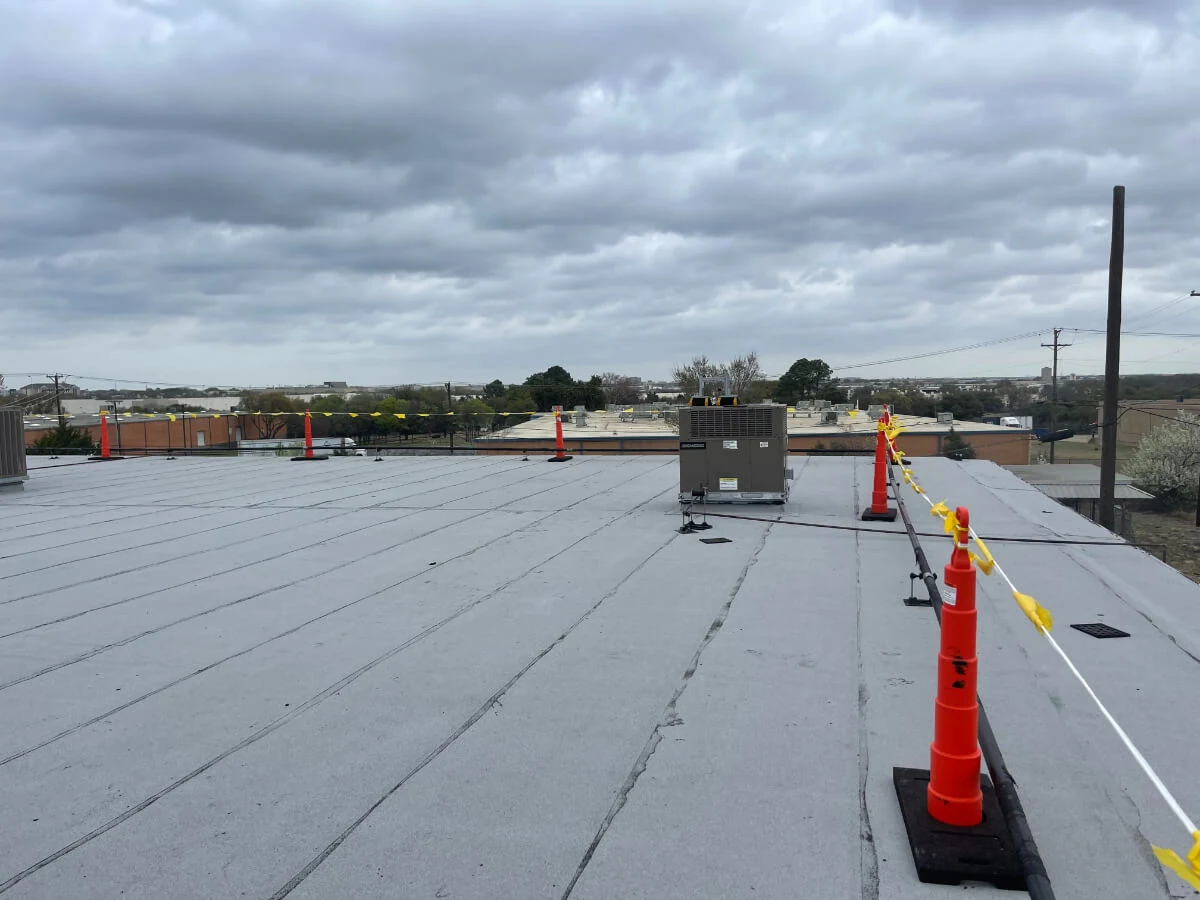
SBS Mod-Bit for Roofs That Take a Beating
SBS modified bitumen is the membrane we bring up when a roof needs more mass and more redundancy than a single-ply system offers - heavier equipment traffic, occasional hail, or an owner who wants a multi-ply system with a longer, more forgiving track record.
Multi-Ply Redundancy Explained
A mod-bit system is typically installed in two plies - a base sheet and a cap sheet - with seams staggered between layers so a weak spot in one ply doesn't line up with a weak spot in the other. That redundancy is the core argument for mod-bit over a single-ply membrane on buildings where a leak would be expensive to chase down.
We see this spec most on buildings with dense rooftop equipment or frequent contractor access, where the odds of an accidental puncture run higher than on a quiet office roof.
Mineral Granules and UV Protection
The mineral-granule surface on a cap sheet does a different job than a smooth single-ply membrane's UV protection. Granules physically shield the asphalt-based material underneath from direct sun, which matters at this elevation where UV intensity runs higher than at sea level almost every day of the year.
Granule loss over time is a real aging indicator we look for on inspections - a cap sheet losing granules in high-traffic areas is showing early wear that will accelerate if it's not addressed with a spot repair or coating.
Reflective granule colors are available on some cap sheet products and cut surface heat gain compared to a standard dark granule finish, which is worth discussing at bid time on any building where cooling load is a real concern for the owner.
Hail and Impact Resistance
Southern New Mexico gets occasional hail with our summer thunderstorm activity, and mod-bit's added mass generally holds up better against impact than a thinner single-ply membrane. It's not hail-proof, but the redundancy of two plies means a hail strike is less likely to punch all the way through to the deck than it would on a single layer.
Application Method and Wind Considerations
Torch-applied and self-adhered SBS systems both show up in our area, and the choice matters more here than in some markets. Torch application on a dry, windy day requires real caution around any nearby dry vegetation or debris, which is a genuine consideration on buildings backing up to open desert lots.
We favor self-adhered or cold-applied systems on sites where torch work raises fire risk, and we plan torch jobs around wind conditions rather than working through a gusty afternoon.
Spring wind events that carry dust across the valley also complicate torch scheduling - visibility and gusting both factor into whether we run a torch crew on a given day, and we'd rather push a start date than rush a detail in bad conditions.
- Ply count and seam stagger pattern reviewed at bid, not only total thickness
- Granule coverage and color for reflectivity versus a smooth cap sheet
- Application method chosen based on site fire risk and wind conditions
- Base sheet attachment method - mechanically fastened or fully adhered
- Flashing detail at parapets and curbs, checked separately from field membrane
- Drain tie-in sized for monsoon burst volume, same as any low-slope system
Monsoon Drainage on a Mod-Bit Roof
Mod-bit roofs drain the same way any low-slope system does, and ponding risk depends on slope and drain placement rather than membrane type. What's specific to mod-bit is that standing water sitting on a granule-surfaced cap sheet for extended periods can accelerate granule loss at that spot, which is another reason we don't let chronic ponding go unaddressed.
Where Mod-Bit Loses to Single-Ply
Mod-bit costs more in material and labor than TPO on a comparable roof, and it's heavier, which matters on older structures with limited load capacity. For a straightforward low-traffic building without hail concerns or heavy equipment, we'll usually still recommend single-ply over mod-bit on cost grounds alone.
We'll check existing structural drawings or work with an engineer on older buildings before recommending mod-bit specifically because of that added dead load, particularly on structures that have already been recovered once or twice and are carrying more roofing weight than the original design accounted for.
Common Mod-Bit Questions From Building Owners
Is SBS mod-bit better than TPO for a Las Cruces roof?
Neither is universally better - mod-bit's advantage is redundancy and mass for hail and traffic resistance, while TPO usually wins on cost for a lower-traffic building. We size the recommendation to the building.
How much does granule loss matter if the roof isn't leaking yet?
It matters as an early warning sign. Bare spots in high-traffic areas mean the asphalt underneath is losing UV protection faster than the rest of the field, and we address it before it becomes a leak.
Is torch-applied mod-bit safe on a roof surrounded by open desert lots?
We evaluate that case by case and often recommend a self-adhered or cold-applied system instead when a site has real fire exposure risk nearby.
Can mod-bit be coated later to extend its life?
Yes, a granulated cap sheet in fair condition can often take a reflective coating to add UV protection and extend service life before a full replacement is needed.
Does mod-bit hold up better against hail than TPO?
Generally yes, due to the added mass and multi-ply construction, though the difference depends on hail size and the specific products being compared.
Related
Ready to review the roof scope?
Request a Roof AssessmentModified Bitumen Roofing Systems in Las Cruces
Modified bitumen remains a useful commercial roofing system where owners need reinforced asphalt sheets, durable detailing, and repair methods that fit the building. The right specification in Las Cruces, NM depends on the deck, existing assembly, drainage, rooftop use, and installation constraints.
Request a Commercial Roof Review
SBS and APP system choices
SBS sheets are formulated for flexibility and are commonly installed with hot asphalt, cold adhesive, self-adhered products, or approved heat-welding methods. APP sheets use a different modifier and are often heat welded by trained crews. The assembly and application method must match the substrate, fire-safety plan, manufacturer details, and site restrictions.
Where modified bitumen fits
The system can be practical on low-slope commercial roofs with frequent service traffic, complex flashing, smaller roof sections, or an existing asphalt-based assembly. Suitability still depends on moisture findings, structural capacity, drainage, insulation targets, and whether tear-off or recover is allowed.
Repairability and recurring leaks
Repairs should identify the actual entry point and the limits of deteriorated material. Open laps, punctures, failed pitch pockets, wall flashing, drains, and edge conditions are reviewed together. Surface patches alone should not conceal wet insulation or movement below the membrane.
Recover versus replacement
A recover can reduce disruption when the existing deck and assembly qualify, but it adds weight and can hide trapped moisture or unstable materials. Replacement exposes the deck and supports a complete insulation and drainage correction. Core cuts, moisture investigation, code requirements, and warranty goals guide the choice.
Installation planning for occupied buildings
Odor, heat, staging, rooftop equipment, pedestrian routes, deliveries, interior sensitivity, and daily dry-in limits belong in the scope. The safest installation method is selected for the actual facility rather than assumed from the membrane name.
Conditions included in the review
- Deck and existing assembly
- Core cuts and moisture findings
- SBS or APP sheet configuration
- Attachment and application method
- Drainage and tapered insulation
- Flashings, penetrations, edges, and warranty details
Related commercial roofing services
Frequently asked questions
What is a modified-bitumen roof?
It is a reinforced asphalt-based membrane system manufactured in sheets, commonly using SBS or APP modifiers and installed as part of a multi-layer commercial roof assembly.
Can modified bitumen be installed over an existing roof?
Sometimes. The existing assembly, deck, moisture, attachment, number of roof layers, code, weight, drainage, and manufacturer requirements must all support a recover.
Can a modified-bitumen roof be repaired?
Often, if the defect and wet-material boundaries can be identified and the remaining membrane can accept a compatible repair. Widespread moisture or deterioration can make replacement more defensible.